ACM CCS 2026
GhostTac: Manipulating Tactile Sensors without Physical Contact
1Zhejiang University 2The Hong Kong University of Science and Technology
*Corresponding author
Abstract
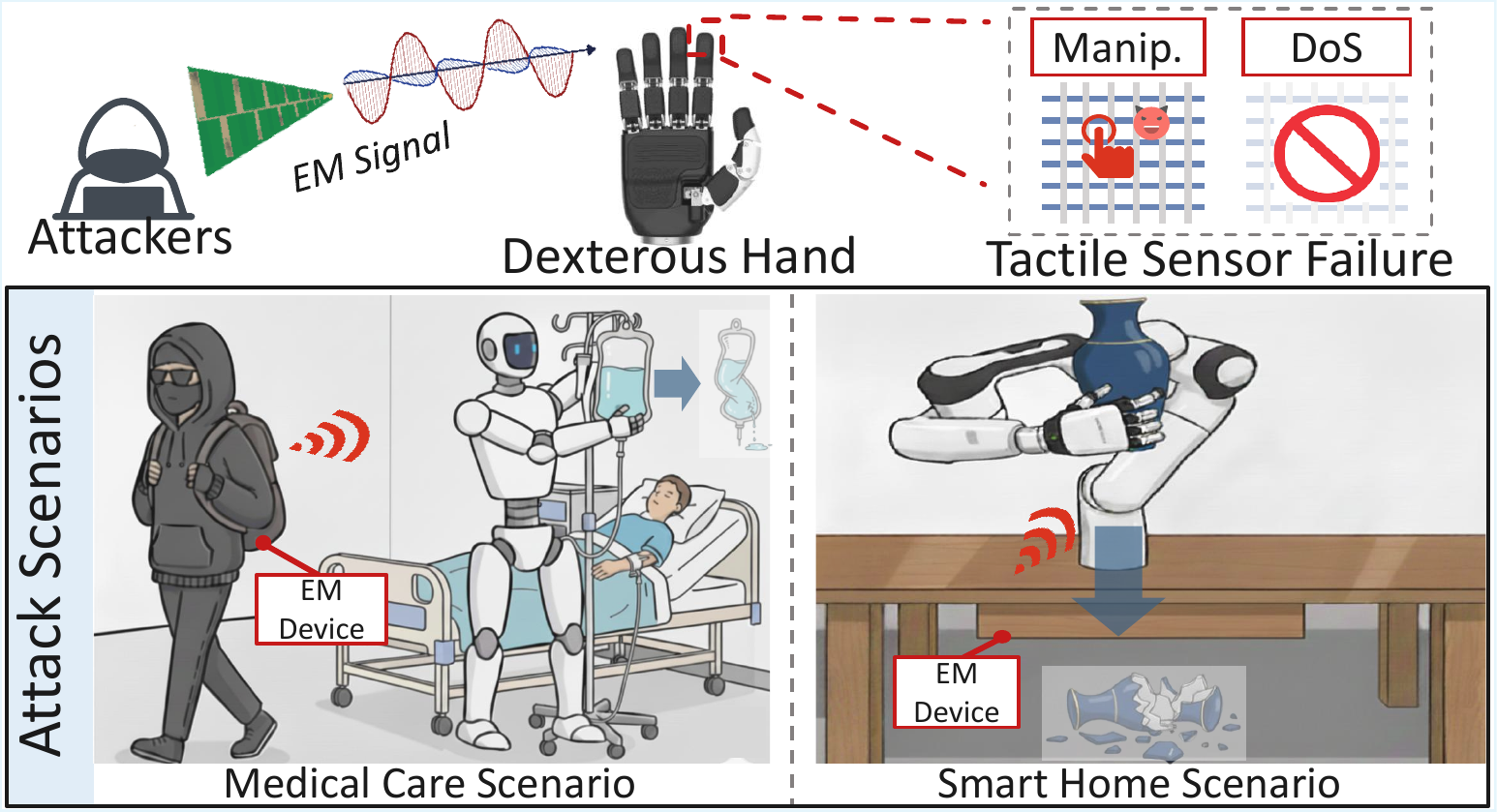
Tactile sensors are integral to modern robotic systems, enabling robots to perceive and interact with the physical environment through tactile feedback. However, the physical-layer security of tactile sensors has received little attention. We present GhostTac, the first contactless attack, to the best of our knowledge, that manipulates tactile sensing through electromagnetic interference (EMI). GhostTac exploits nonlinear rectification and limited-bandwidth amplification, converting carefully crafted EMI signals into persistent DC offsets that bypass onboard filtering and induce stable measurement deviations. It enables fine-grained, controllable manipulation of sensor outputs by shaping the spatial distribution and magnitude of interference at targeted locations. Such manipulation can induce harmful robot behaviors, including excessive force that may damage objects or injure people. We evaluate GhostTac on 10 sensor modules and two dexterous hands, covering 15 tactile sensors of different types, and demonstrate consistent effectiveness across all tested devices. Three case studies involving tactile grasping, slip detection, and material classification further illustrate its practical impact on real robotic tasks. These findings reveal a new physical attack vector against tactile sensing in robotic systems.
Background
From tactile array to tactile information
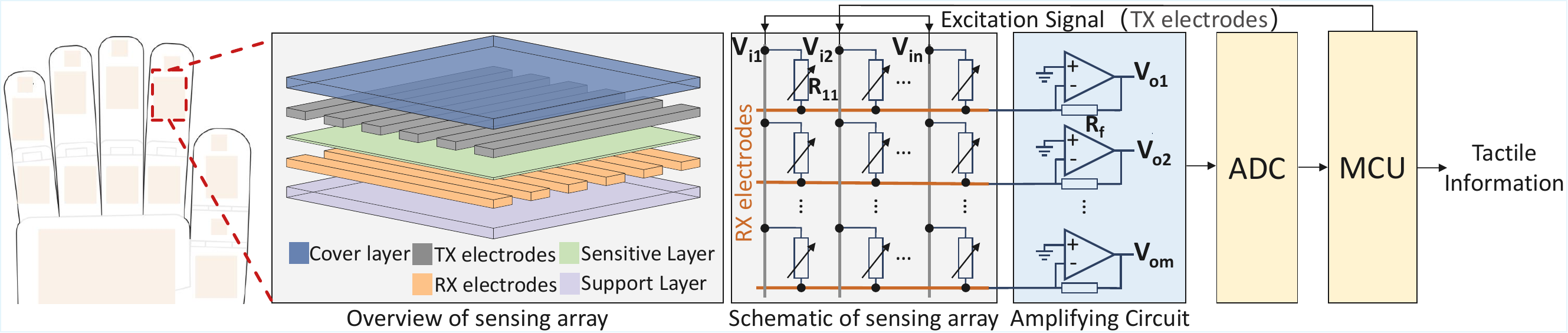
Tactile sensing begins at the sensor array and proceeds through amplification, digitization, and microcontroller processing. This shared architecture is the basis for understanding how an external disturbance can affect the reported tactile information.
01 / TACTILE SENSING SYSTEM
Physical contact becomes a digital tactile signal through a layered sensing and processing path.
Pressure changes at the TX-RX intersections alter the sensor output. The array is scanned, conditioned by the amplifying circuit, digitized, and finally translated into tactile information for the robotic system.
Principle
Why the disturbance can become a stable error
The paper identifies a circuit-level mechanism that explains why high-frequency EMI can affect low-frequency tactile measurements.
02 / CIRCUIT-LEVEL EFFECT
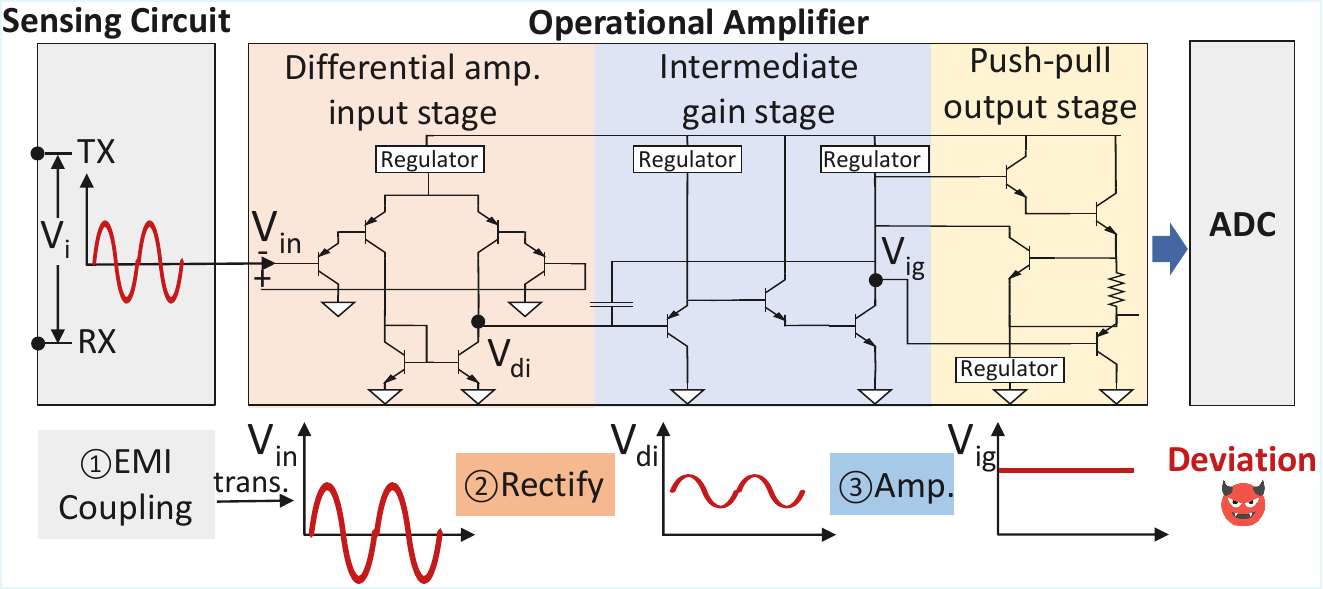
Coupling, rectification, and amplification produce a persistent offset.
An external signal can couple into the sensing circuit. Nonlinear behavior in the amplifier input stage rectifies part of the signal, after which amplification preserves a DC component that appears as a deviation in the tactile measurement.
03 / SYSTEM-LEVEL WORKFLOW
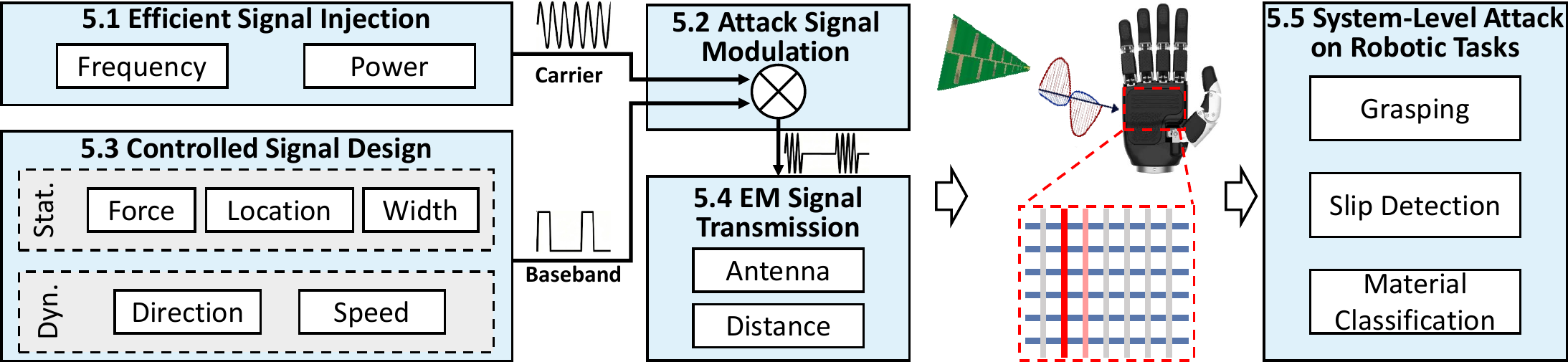
The circuit-level effect can propagate to tactile-driven robotic tasks.
At the system level, the paper links controlled sensing-side deviations to demonstrations in grasping, slip detection, and material classification. This figure provides the overall research workflow without exposing operational parameters.
Demonstrations
Robotic task case studies
All existing demonstration videos and original setup images are retained below. They are grouped by task to make comparisons easier to follow.
01 Grasping8 demonstrations
Positive interference can lead to object dropping; negative interference can lead to excessive grasping. The original demonstrations cover bottles, an artificial hand, and a paper cup.
02 Slip detection2 demonstrations
By altering the sensing result, the attack can generate a false slip event or suppress the indication of a real slip.
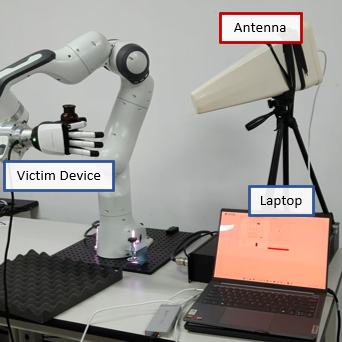
03 Material classification2 demonstrations
The demonstrations compare the variation in tactile measurements under normal and interference conditions during material classification.
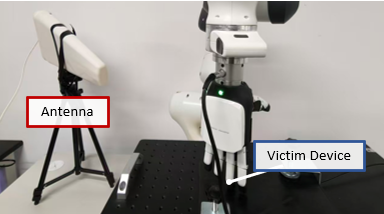
04 Real-world scenarios6 demonstrations
These demonstrations show pre-positioned and passing-by scenarios, each with normal, positive-interference, and negative-interference conditions.